The Scientific Method
Scientific research is a way of investigating the world that allows us to draw testable conclusions about how it works. It is an ongoing process, in which researchers test, reshape and retest their ideas in the light of new evidence.
Francis Bacon (1561-1626) is often credited with being the father of the modern scientific method, which is used in all research. It is based on inductive methods that can be used to draw conclusions based on limited observation.
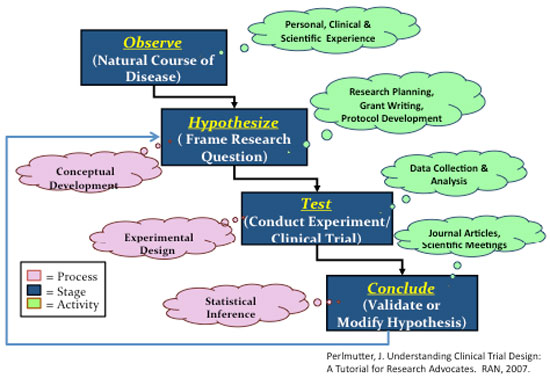
To start with, researchers draw up an idea, or hypothesis, based on available evidence and observations, such as the results of previous experiments. Then the scientists carry out carefully designed studies, or experiments, to test their hypothesis. They collect and record detailed information and measurements, and analyze the data to see if it supports their idea or not. (see schematic below)
It is also important that results are reproducible and reliable. Researchers will repeat the same experiment several times to make sure they get the same result. And they will also use controls (A sample in which a factor whose effect is being estimated is absent or is held constant, in order to provide a comparison), to ensure that their results are real.
The scientific method is depicted in this figure:
1. The four key stages that build on each other are shown in the center, blue boxes:
Observe
Entails both formal and informal observation.
Hypothesize
Articulates the research question in a testable format (experiment or clinical trial).
Test
Entails experimentation. Clinical trials are experiments that involve patients.
Conclude
Validates or modifies the hypothesis. The conclusion generally leads to additional observation and experimentation.
2. The green clouds on the right side of figure provide examples of activities involved in each stage.